Keeping Watch in the Night: A Christmas Address

“So she pointed to the baby. They exclaimed, ‘How can we talk to someone who is an infant in the cradle?’ Jesus declared, “I am truly a servant of Allah. He has destined me to be given the Scripture and to be a prophet. He has made me a blessing wherever I go, and bid me to establish prayer and give alms-tax as long as I live, and to be kind to my mother. He has not made me arrogant or defiant. Peace be upon me the day I was born, the day I die, and the day I will be raised back to life!’”
Qur’an 19:29–33
What follows is a Christmas address written from within my own Islamic faith, offered in a spirit of reverence, restraint, and goodwill toward my Christian neighbors, family, and friends. This reflection grows out of a long personal engagement with both Christian and Islamic spiritual traditions. Please forgive any shortcomings that remain therein.
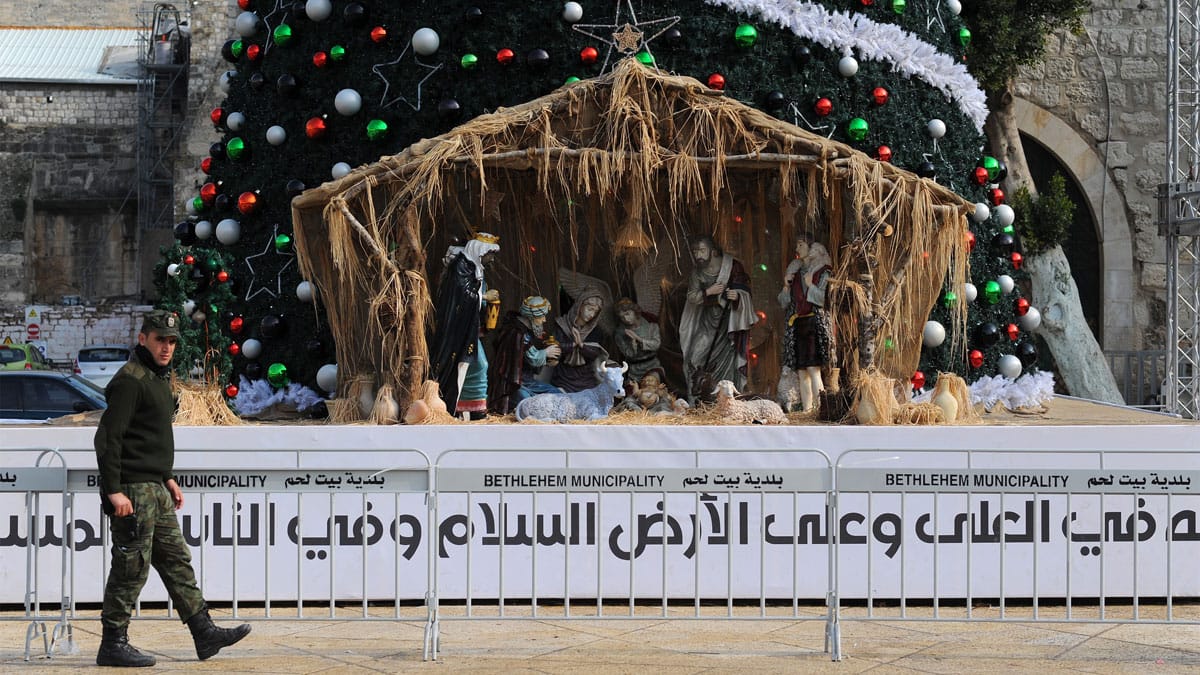
As a young boy raised in a Christian home and a largely Christian society, Christmas has been close to my heart for as long as I can remember. And of course, as I grew older and as my own faith deepened and matured, the season of Christmas — with both its fasts and its feasts, its joys and its waitings — grew even more in my time in monastic life as a monk. And now, as a Muslim, I find that same reverence for the season deeply imbedded and ingrained in me, yet with a new outlook and a new meaning. However, when Christmas becomes reduced to nostalgia, to secular habit, or — worse — to another front in our culture wars, its deeper purpose is lost. This is especially painful in a world where suffering continues unabated: where Palestinian Christians mark Christmas amid devastation in Gaza, and where tensions between Christians and Muslims are increasingly sharpened in my own home of the United States and elsewhere. In such a moment, the question presses itself upon us: what can believers still hold in common in a season that names the coming of the Prince of Peace?
In times like ours — times marked by strain, uncertainty, and mutual suspicion, it becomes easy for religious communities to lose sight of what faith is meant to do within the human heart. Noise and rhetoric multiplies, tribal identities harden, and sacred language is too often pressed into the service of fear or resentment. Yet seasons like Christmas offer a different invitation: to slow down, to listen more carefully, and to recover the interior seriousness without which religion becomes empty. A “sounding brass, or a tinkling cymbal”. A spectacle.
For Christians, Christmas marks the mystery of the Word made flesh — the conviction that divine meaning does not remain distant from human life, but draws near in humility, vulnerability, and love. This intuition deserves reverence. It affirms that God does not abandon history, that suffering is not beneath divine concern, and that truth is not communicated only through power or command, but through a humble presence. As the Gospel says, “The light shines in the darkness, and the darkness has not overcome it.” It is that still, small voice that cries out in our modern moral wilderness.
From within Islam, this movement toward nearness is deeply familiar. The Qur’an speaks of a God who is closer than we imagine: “We are nearer to him than his jugular vein” (50:16). Revelation, in the Islamic understanding, is not given merely to define belief, but to transform the inner life — to purify the heart, restrain the ego, and awaken moral responsibility. Faith is not proven by intensity of speech or certainty of posture, but by sincerity, patience, and truthfulness before God.
At their deepest levels, Christianity and Islam converge on this demand. Both insist that love of God cannot be separated from love of one’s neighbor, and that devotion without humility is empty and hollow. The Qur’an reminds us that lasting change begins within: “God does not change the condition of a people until they change what is within themselves” (13:11). The Christian scriptures speak with equal severity: “Those who say, ‘I love God,’ and hate their brothers or sisters, are liars.” These are not merely nice and sentimental platitudes for Hallmark cards. These are Divine Judgements.
Christmas, then, is not only a celebration. It is not mere Jingle Bells, egg nog, and nostalgia. It’s not just visiting family or giving gifts. It is an invitation — and a test. It asks whether our faith has made us more honest with ourselves, more gentle with others, and more capable of a love that bears cost. If God truly draws near to us, then we are called not to be fearful, but to become more worthy of that nearness through restraint, humility, mercy, and justice.
For Muslims, honoring this season as an important Christian holy day does not require confusion or compromise. It requires seriousness of intention and beauty of conduct. The Qur’an instructs believers to address the People of the Book “in the most beautiful manner” (29:46), reminding us that reverence, courtesy, and patience are not theological concessions, but acts of fidelity to God. Unity does not mean sameness, but it does demand a refusal to dehumanize.
In a world where such restraint often feels fragile, it is easy to sense a growing darkness. Like the shortening days of December and the waning of the light in these cold weeks, it can seem that hope itself has withdrawn, and that the love of people for one another has grown cold. Yet both Christians and Muslims — each in our own way — confess that God is always near, and revelation insists that darkness is never the final word. The Qur’an reminds us, “With hardship comes ease; with hardship comes ease” (94:5–6). Hope, then, is not mere optimism, but trust in God: a trust that remains when appearances fail, and that keeps a small light alive through patience, faithfulness, and humility.
It is in this light that Muslims also remember Maryam and her son ʿĪsā, peace be upon him — signs of God’s mercy given to the world through humility, trust, and faithfulness. Their story reminds us that God’s work in history often arrives quietly and without spectacle, entrusted to those willing to bear hope patiently rather than proclaim it loudly.
So I offer this greeting to my Christian neighbors, family, and friends. May this season soften what has grown hard. May it deepen what is real and, like the falling snow on Christmas Eve, may it quiet what is noisy. May it draw us closer to God by making us more truthful, more patient, and more capable of love that does not seek to dominate or impress.
Peace to those who keep watch in the night.
And goodwill to all who seek God with sincerity.
If you like this content, please consider a small donation via PayPal or Venmo. I am currently studying Islam and the Arabic language, and any donation — however small! — will greatly help me to continue my studies, my work, and my sustenance. Please feel free to reach me at saidheagy@gmail.com.
Thank you, and may God reward you! Glory to God for all things!